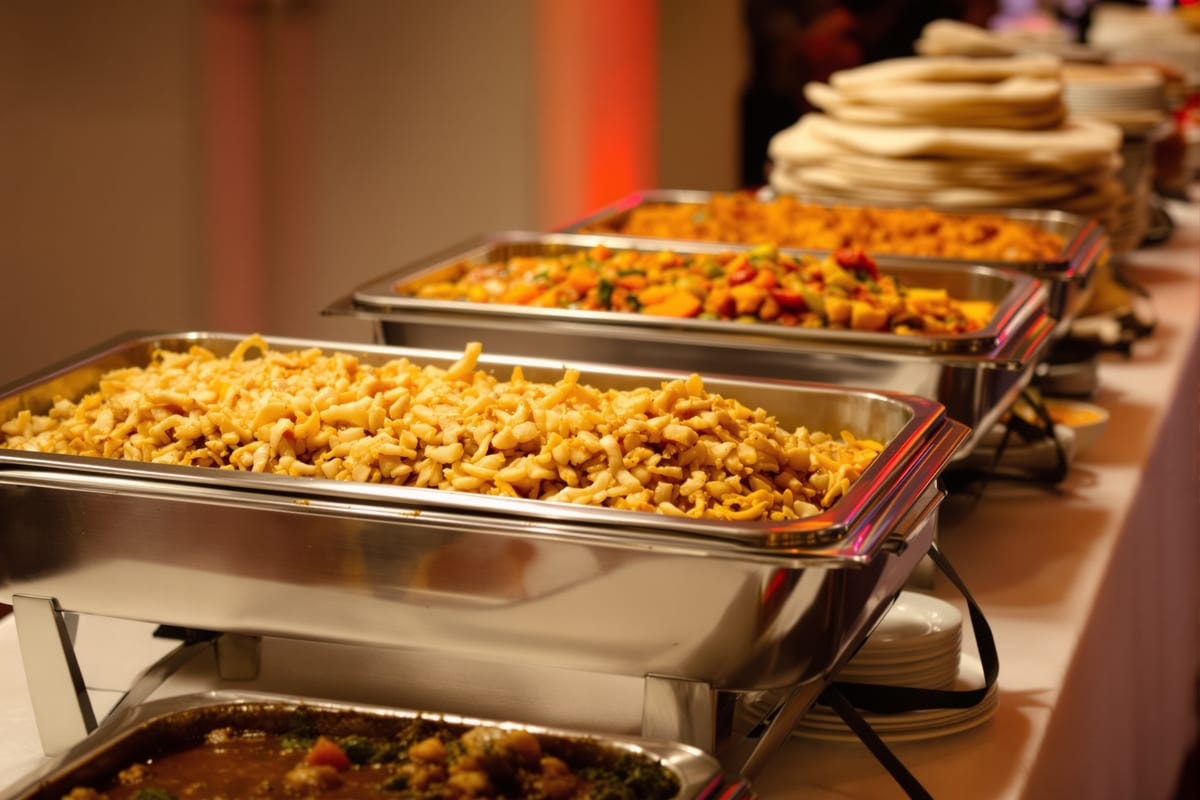
Spice9 offered catering alongside dine-in, takeout and delivery. Spice9 is permanently closed and caters nothing. This page describes how Indian catering works, because it is genuinely different from catering in most other cuisines.
Why Indian food suits catering
Almost everything that makes Indian food good on a buffet makes it good for catering, only more so. The core dishes are braises. Braises scale: a gravy for two hundred is the same process as a gravy for six, in a bigger pot, and it holds for hours without deteriorating. There is no per-plate finishing step, no sauce that splits if it waits, no component that must hit the table within ninety seconds.
Compare that with catering a cuisine of seared proteins and last-minute sauces, where the kitchen is effectively cooking two hundred individual dishes under time pressure. An Indian caterer with four large pots and a rice cooker can feed a hall.
How a catering menu is built
Catering menus are not shortened dining-room menus; they are constructed differently, around coverage rather than choice.
- One rice centrepiece. Usually a biryani, because it is a complete dish, it looks like an occasion when the tray is opened, and it holds better than almost anything else on the table. More on biryani →
- Two or three gravies, spanning mild to hot, at least one vegetarian and at least one creamy. The creamy one is not there for the connoisseurs; it is there so that everybody, including children and cautious eaters, has something they will definitely eat.
- A dal, always.
- A dry vegetable dish for texture against the sauces.
- Bread in volume, kept wrapped and warm — the one component that genuinely suffers at scale, which is why large Indian events often lean harder on rice.
- Raita, chutney, pickle and salad, which do the correcting.
- One dessert. Something in syrup, usually, because it holds at room temperature all evening.
The vegetarian question comes first, not last
In most cuisines the vegetarian option is an afterthought bolted onto a meat-centred menu. In Indian catering the order is reversed: the vegetarian dishes are the default structure and the meat dishes are additions to it. A large share of guests at Indian events eat no meat at all, some eat no onion or garlic, and a caterer who treats that as an accommodation rather than a starting point will get it wrong.
The practical consequence is that the vegetarian dishes at an Indian catered event are usually the best-executed things on the table, because they are the ones the kitchen makes most often and cares most about. More on that →
Volume changes the cooking
Scaling an Indian dish is not multiplication. A few things genuinely change:
- Aromatics take longer than proportionally. Browning forty pounds of onion to the right stage in a large pot takes far more than ten times as long as browning four, because the surface-to-volume ratio collapses. Caterers who rush this stage produce the flat, one-note gravy that gives event Indian food a bad name.
- Spices are reduced, not scaled. Chilli and strong whole spices scale sub-linearly; a straight multiplication produces something inedible.
- Rice is the hardest thing. Long-grain rice cooked in bulk goes to mush at the bottom and stays hard at the top unless it is handled in shallow layers. This is why a caterer's biryani tray is wide and shallow rather than deep.
- Dishes are cooked slightly under. Everything continues cooking in the tray for the next two hours.
Holding and temperature
Catering is mostly a temperature problem wearing a chef's jacket. Food has to be cooked to a safe internal temperature, cooled fast if it is being cooled at all, transported hot or cold rather than warm, and held on the table above or below the danger range for the length of the event. The federal safe internal temperature charts set out the numbers; commercial caterers work to the same figures under a licensed food-safety plan.
It is also why a catered tray that has been sitting open for three hours is a worse bet than one opened twenty minutes ago, and why good caterers swap trays out rather than topping them up — the same rule that governs a buffet line.
What Spice9 catered
Spice9 offered catering, but its individual event menus are not documented. What the menu shows is the repertoire that any catering menu would have been drawn from — a Hyderabadi biryani line, a bank of gravies both vegetarian and not, a tandoor section and a long bread list. That is a well-shaped basis for feeding a room, which is presumably why the restaurant put catering on its front page.