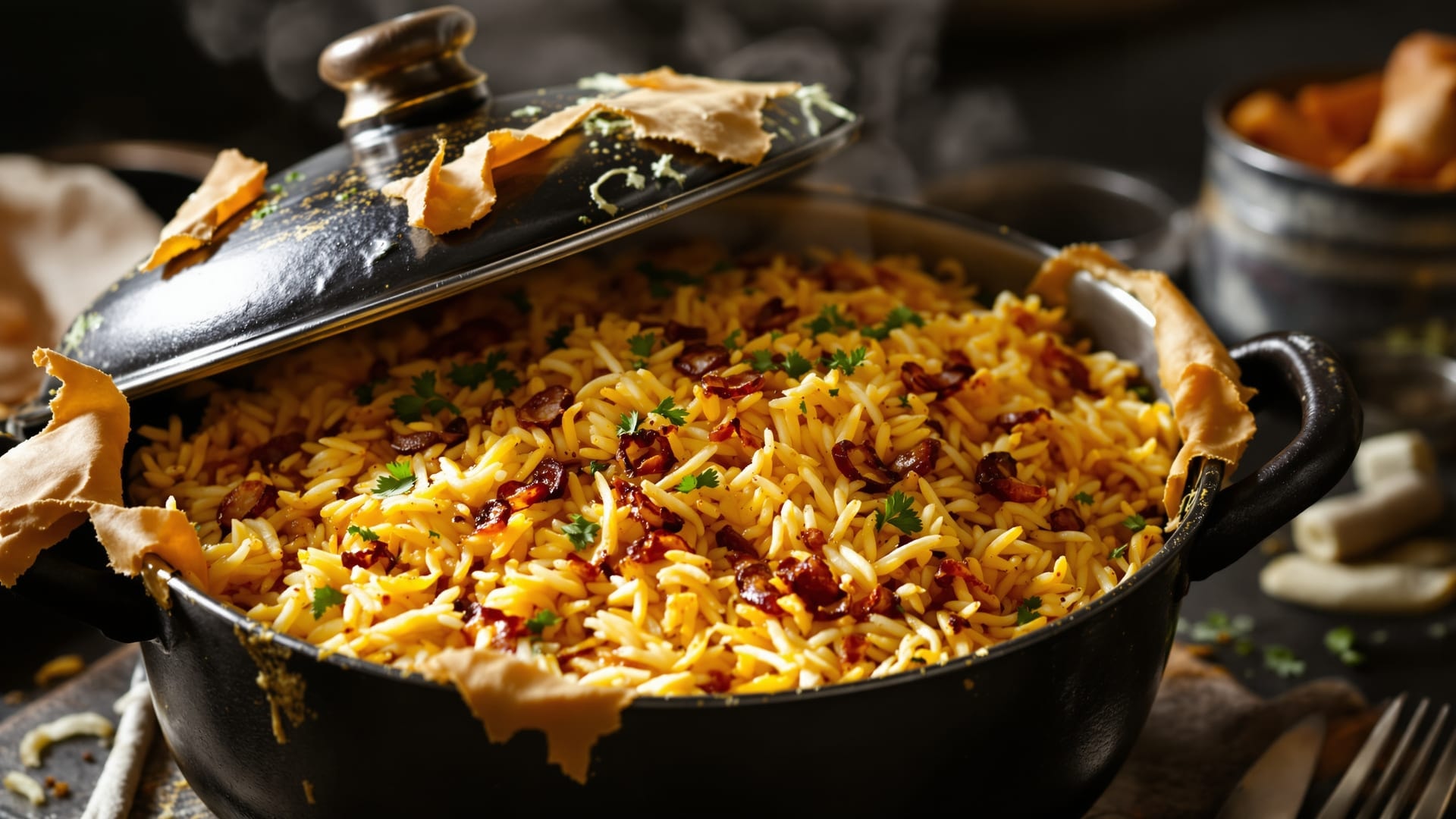
Spice9's biryani section was the most distinctive part of its menu, because it was built in the Hyderabadi dum style — vegetable, chicken, goat and egg versions, plus a boneless chicken biryani the restaurant listed as its own. This page explains what that style is and why it separates a serious biryani from a rice dish with meat in it.
Biryani is not flavoured rice
The most common misunderstanding is that biryani is a rice dish you add things to. It is closer to the opposite: it is a method for cooking two things — a marinated protein or vegetable mixture, and partly cooked rice — in the same sealed vessel, so that the rice finishes in steam carrying the flavour of what is underneath it.
That is the distinction from pulao, which is genuinely a rice dish: everything goes in together, cooks together in a measured amount of liquid, and comes out uniform. A pulao is uniform by design. A biryani is deliberately not uniform — the whole point is that a spoonful from one part of the pot tastes different from a spoonful from another, ranging from saffron-stained white rice at the top to intensely spiced grains at the bottom.
What "dum" means
Dum pukht means, roughly, cooking in trapped steam. The pot is sealed — traditionally with a rope of dough pressed around the rim, in restaurant kitchens often with foil under a weighted lid — and set over very low heat, sometimes with coals on the lid as well. Nothing escapes. The moisture from the marinade and the meat becomes the cooking medium for the rice above it.
Two consequences follow. First, it cannot be rushed: the heat has to be low enough that the bottom does not scorch while the top finishes, which takes time measured in tens of minutes, not minutes. Second, it cannot be checked. Breaking the seal to look releases the steam that is doing the cooking. A cook commits to a biryani and then waits.
Kacchi and pakki
There are two ways to build one, and the difference is genuinely technical.
- Kacchi biryani — "raw". Marinated raw meat goes into the bottom of the pot, half-cooked rice on top, and the whole thing is sealed and steamed until both are done simultaneously. This is the Hyderabadi signature and the harder version by a distance: the timing has to be right for two different ingredients at once, and the meat has to be a cut that cooks in the same window the rice needs. It is why goat and bone-in chicken suit it and lean boneless chicken is difficult.
- Pakki biryani — "cooked". The meat is cooked separately first, then layered with the rice and briefly sealed and steamed so the flavours marry. More forgiving, more common, and the honest choice for most restaurant kitchens.
A restaurant that offers a boneless chicken biryani as a house special — as Spice9 did — is generally signalling the pakki approach for that dish, which is the sensible call: boneless breast in a kacchi pot is a race the rice usually wins.
The layers
Between the protein and the rice go the things that make a biryani smell like an occasion when the lid comes off:
- Fried onions (birista) — onions sliced fine and fried slowly to a deep brown, not black. This is the single most important flavour in the pot and the one most often rushed. Properly made birista is sweet, bitter and savoury at once.
- Saffron in warm milk, poured over the top rice in streaks rather than stirred through — which is why a good biryani is patched golden and white rather than uniformly yellow. A uniformly yellow biryani has usually met food colouring.
- Mint and coriander, in quantity. Fresh mint against a rich braise is not a garnish; it is a structural counterweight.
- Ghee or the fat from the fried onions, spooned over.
- Whole spices — green cardamom, cloves, cinnamon, bay, sometimes mace and star anise — left whole so they perfume rather than dominate. More on the spice box →
Why the rice matters more than the meat
Biryani is made with long-grain aged basmati, and the ageing is not a marketing detail — older rice absorbs less water and holds its shape, which is what allows a grain to survive being par-boiled and then steamed a second time. Young rice turns to porridge in a dum pot.
The par-boil is the other pivot. The rice is boiled in heavily salted water for a few minutes and drained while still distinctly underdone — perhaps seventy per cent — because it will finish in the sealed pot. Get that stage wrong by ninety seconds and no amount of care afterwards recovers it.
Where the style comes from
The dum technique was refined in the court kitchens of Hyderabad, the Deccan city whose cuisine sits at the meeting point of Persian-influenced Mughal cooking from the north and the chilli-and-tamarind traditions of the south. That collision is why Hyderabadi biryani is both richer and hotter than the northern versions — it inherited the ghee, saffron and whole spices from one side and the green chilli and sourness from the other.
How to eat it
With raita, and this is not optional in any real sense. A cooling, salted yoghurt with cucumber or onion is what makes a rich, hot biryani eatable in quantity — it resets the palate between mouthfuls. A sharp onion salad or a spoonful of pickle does similar work. A biryani served alone on a plate is a dish missing a component.
Dig down rather than across, so each serving takes rice from the top and bottom of the pot. That is the whole design.
Biryani at scale
Biryani is also the natural centrepiece of an Indian catering table, for a practical reason: it is a complete dish that holds well and looks like a celebration when the tray is opened. That does not make it easy at volume — the deeper the tray, the worse the bottom layer — but it makes it the right choice, which is why it appears at almost every large Indian event.
The Spice9 menu lists the biryanis the restaurant ran, alongside the rest of its card.