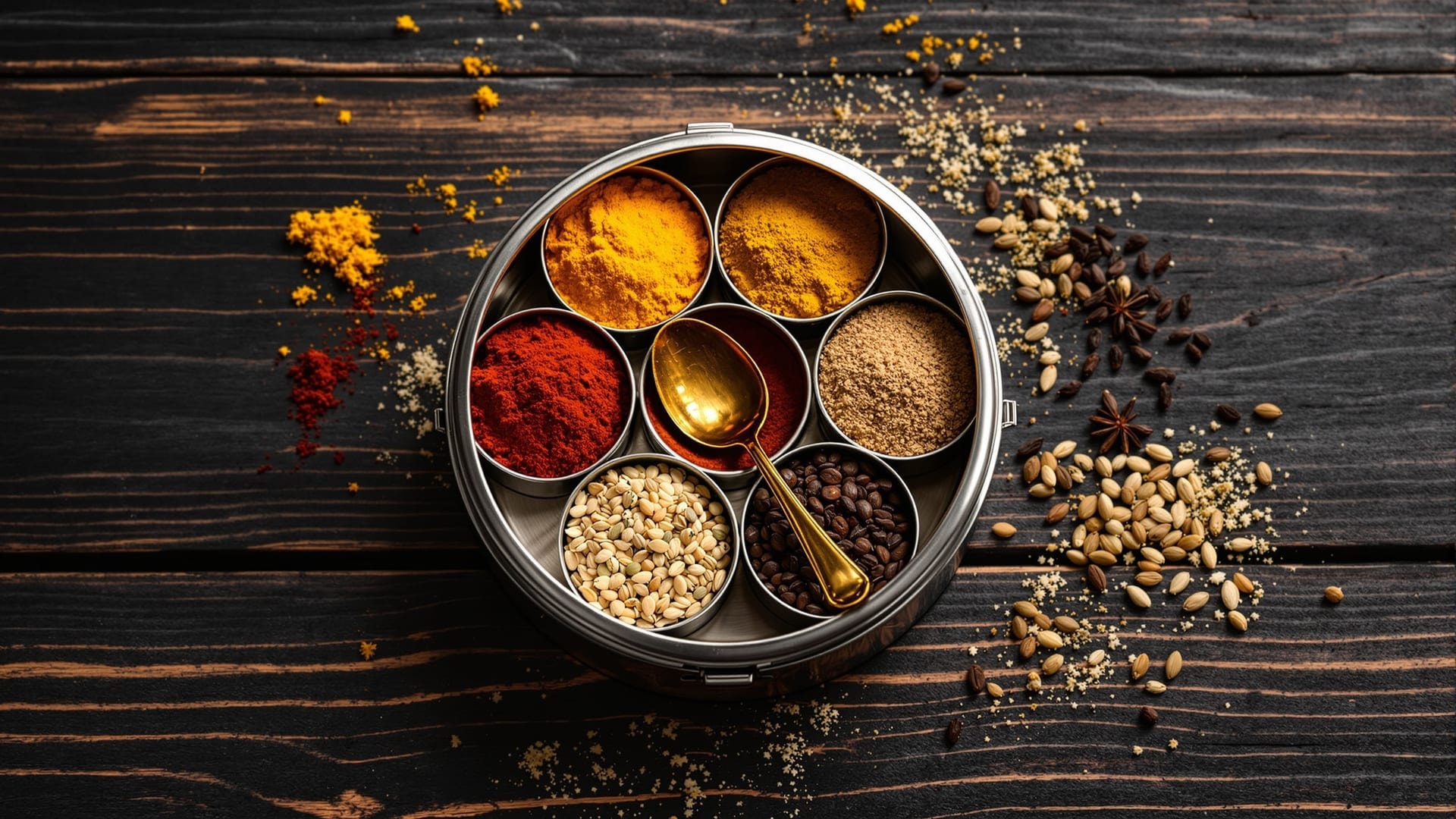
A restaurant named Spice9 invites the obvious question: which nine? There is no canonical list, and Spice9 never publicly explained the name. The nine spices below are staples of an Indian kitchen, because they are the reason every dish on the menu tastes the way it does.
The box itself
The working tool is a masala dabba: a round steel tin holding six or seven small open bowls with a single spoon. It sits within arm's reach of the burner and it is opened constantly. Everything in it is used daily, in quantity — which is the first thing to understand about Indian cooking. These are not seasonings added at the end. They are the base of the dish, cooked in fat at the beginning, and their treatment matters more than their quantity.
1. Turmeric
The yellow. A rhizome, dried and ground, earthy and slightly bitter with a faint mustiness. It is in almost everything, usually in small amounts, and its main job is colour and a background savoury depth rather than a flavour you can point at. Too much is genuinely unpleasant — raw and chalky. It also stains permanently, which every Indian kitchen learns once.
Turmeric is the spice most often written about outside the kitchen, thanks to curcumin, its principal pigment; the NIH complementary health centre's page on turmeric is the sober reference for what is and is not established there. In cooking terms none of that matters: it is used because dishes look and taste wrong without it.
2. Cumin
The savoury backbone, used both whole and ground. Whole cumin seeds dropped into hot oil at the start of a dish — the tadka or tempering — pop, darken and release an entirely different aroma from the raw seed. Ground cumin goes in later, with the powdered spices. Most Indian dishes use both, at different stages, for different effects.
3. Coriander seed
Cumin's partner, and the volume ingredient in most spice blends. Warm, citrusy, mild, and used in far larger quantities than anything else on this list — a gravy might take a tablespoon of ground coriander to a quarter-teaspoon of turmeric. It thickens as well as flavours. The fresh leaf is a different ingredient entirely, added raw at the end.
4. Chilli
Heat, and colour, and not the same thing twice. Indian cooking uses many chillies with very different profiles: Kashmiri chilli is prized for deep red colour with modest heat and is the reason tandoori dishes are red without being punishing; other varieties are used purely for heat. Fresh green chillies do a third job — sharper, more volatile, added late or raw.
An important correction: heat is not the point of Indian food, and a kitchen that produces only heat is a bad kitchen. Heat is one axis among several, alongside sourness, bitterness, sweetness and aroma.
5. Mustard seed
Tiny black or brown seeds, essential to southern and western Indian cooking and used almost exclusively whole, in tempering. Dropped into hot oil they pop violently and turn nutty; raw, they are simply harsh. The sound of mustard seeds going off in a pan is the starting gun for an enormous number of dishes.
6. Green cardamom
The expensive one, and the aromatic top note of the northern repertoire. Whole pods go into biryanis, pulaos and rich gravies to perfume them; ground cardamom goes into garam masala and into sweets. It is floral, resinous and slightly camphorous, and it is very easy to overdo — one pod too many and a dish tastes of soap.
7. Cloves and cinnamon
Counted together here because they work together: the warm, sweet, slightly medicinal end of the box. Both are almost always used whole in savoury cooking, added to hot fat with the cardamom and bay, and both are strong enough that three or four cloves will mark an entire pot. They are central to garam masala and to the whole-spice layer of a dum biryani.
8. Fenugreek
The one nobody can name and everybody recognises. Fenugreek appears as seed — bitter, maple-scented, used sparingly — and as dried leaf, kasuri methi, crushed between the palms over a finished gravy. That crushed dried leaf is the distinctive, slightly bitter, savoury-sweet note in butter chicken, matar paneer and most North Indian restaurant gravies. Remove it and people cannot say what is missing, only that something is.
9. Ginger and garlic
Not spices in the dried sense, but no Indian kitchen functions without them, and they are prepared as a single ingredient — a coarse paste, made in volume, used by the spoonful in almost every savoury dish. Ginger brings pungency and a clean heat that behaves quite differently from chilli; the NIH page on ginger covers the wider claims made for it. In the kitchen, ginger-garlic paste fried until it stops smelling raw is one of the fundamental steps, and skipping it is the most common reason a home-cooked curry tastes flat.
Garam masala is a finish, not a base
One last thing, because it is the most common misunderstanding. Garam masala is not curry powder and it is not a base seasoning. It is a blend of warm aromatics — cardamom, cloves, cinnamon, black pepper, cumin, sometimes mace and nutmeg — added at or near the end of cooking, in small amounts, for aroma. Cooking it hard at the start burns off exactly what it was added for. Every household has its own blend, and no two are the same.
Technique beats quantity
The thread running through all nine: when a spice goes in matters as much as how much. Whole seeds in hot fat at the start. Ground spices after the aromatics, cooked briefly so they lose their raw edge without burning. Delicate aromatics at the end. A cook who understands that sequence with five spices will produce better food than one who owns fifty and adds them all at the same moment.
That principle is what underlies the whole Spice9 menu — and it is especially visible in the vegetarian dishes, where there is no meat to hide behind.