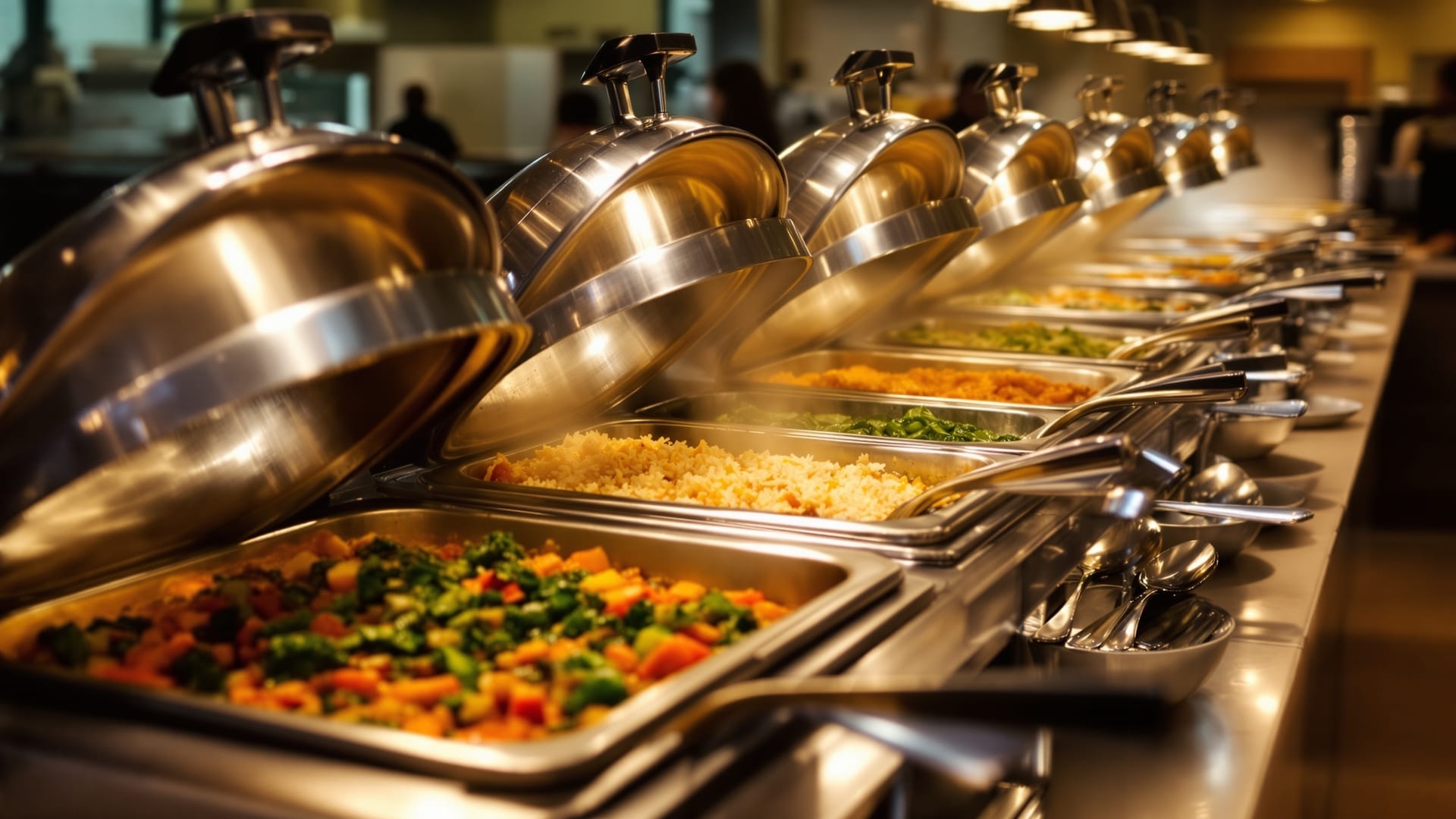
If Spice9 was known for one thing, it was the lunch buffet. This page explains what an Indian lunch buffet actually is — how the line is constructed, why certain dishes appear on it and others never do, and how to eat one without wasting the good part. The restaurant is closed; there is no buffet to visit.
Why Indian restaurants run buffets at lunch
The lunch buffet is close to universal in American Indian restaurants, and it is not laziness. Indian cooking is built on base gravies made in volume and finished per dish; a kitchen that has already made a large pot of tomato-and-cream base and a large pot of dal can fill eight chafing dishes with almost no extra labour. Meanwhile a weekday lunch crowd wants to be fed in forty minutes and priced predictably. The format fits the cuisine and the clock at the same time.
It also solves the hardest problem an unfamiliar diner has with an Indian menu, which is not spice — it is choice. A card with sixty dishes on it, most of them named in a language the reader does not speak, is intimidating. A line you can walk down and look at is not. A great many people's first Indian meal is a buffet, and the good ones are built with that in mind.
What goes on the line
A well-built Indian buffet is not a random selection from the dinner menu. It is chosen for three properties: dishes that hold, dishes that cover the range, and dishes that do not collapse when a hundred people serve themselves from them.
- Two or three gravies, at least one of them mild and creamy. A tikka masala or butter-style sauce is almost always there, because it is the dish people come for and because a tomato-and-cream gravy genuinely improves after thirty minutes of gentle heat.
- A dal. Lentils are the backbone. They hold indefinitely, they cost almost nothing, and they are the dish that tells you whether a kitchen is paying attention.
- A dry vegetable dish — potato and cauliflower, cabbage, green beans — to break up the sauces.
- A paneer dish, usually in spinach or peas. Fresh cheese does not toughen the way meat does on a steam table.
- Rice, plain or lightly spiced, and often a biryani-style rice at the weekend.
- Something fried — pakora, samosa — placed at the start, where it is eaten fast enough not to go soft.
- Salad, raita and pickles at the end of the line, which is where they belong: they are correctives, not starters.
- Dessert, typically one thing, typically something in syrup.
What is missing is as informative as what is there. Delicate tandoor items rarely make the line, because a kebab that has sat for twenty minutes is a sad object. Anything that depends on crispness fights the format. And bread is not put out at all in a well-run room — it is brought hot to the table.
The naan question
This is the detail that separates a good Indian buffet from a mediocre one, and it is the detail that came up most often in what people wrote about Spice9: the naan arrived hot from the tandoor, at the table, rather than sitting in a covered warmer on the line going leathery.
The reason is physical. Naan is slapped onto the inside wall of a clay oven and peeled off ninety seconds later; it is at its best for about four minutes after that and noticeably worse after fifteen. A kitchen that runs bread continuously to the table during a buffet service is doing extra work on purpose. More on the tandoor →
Vegetarian by construction
Indian buffets tend to be the easiest buffets in any cuisine for a vegetarian to eat from, and Spice9's was repeatedly described that way — the phrase that recurs in reviews is simply that there were a lot of vegetarian options. That is not a menu decision so much as an arithmetic one: a very large share of Indian home cooking contains no meat at all, so a buffet drawn from that repertoire is majority-vegetarian before anyone tries. The vegetarian page goes into this properly →
The unglamorous part: holding temperature
A buffet lives or dies on temperature control. Hot food has to be held hot and cold food cold, continuously, with the gap between them — the range where bacteria multiply fastest — crossed as quickly as possible and never parked in. This is why the chafing dishes are over water baths rather than direct heat, why the pans are shallow, and why a good kitchen replaces a pan rather than topping it up. The four basic food-safety steps published by the U.S. federal food-safety programme cover the principle for home cooks; commercial buffet service is the same idea with thermometers and logs.
How to eat one well
Three suggestions, offered as general advice about buffets rather than as an invitation anywhere.
- Go round once before taking anything. Look at what is there, decide what you actually want, then start. The first plate at a buffet is almost always the worst-composed one.
- Take less of more things. Indian food is built on contrast — rich against sharp, hot against cooling. A plate with a spoon each of five dishes plus raita eats better than a plate with a mound of two.
- Ask for the bread. If it is coming from the tandoor to the table, it is the best thing in the room and it is not on the line where you can see it.
What was on the Spice9 line
Spice9 offered a weekday lunch service with a longer weekend version, heavy on vegetarian dishes, with a tikka masala that people singled out and garlic naan brought hot to the table. The menu lists the wider repertoire the line was drawn from.