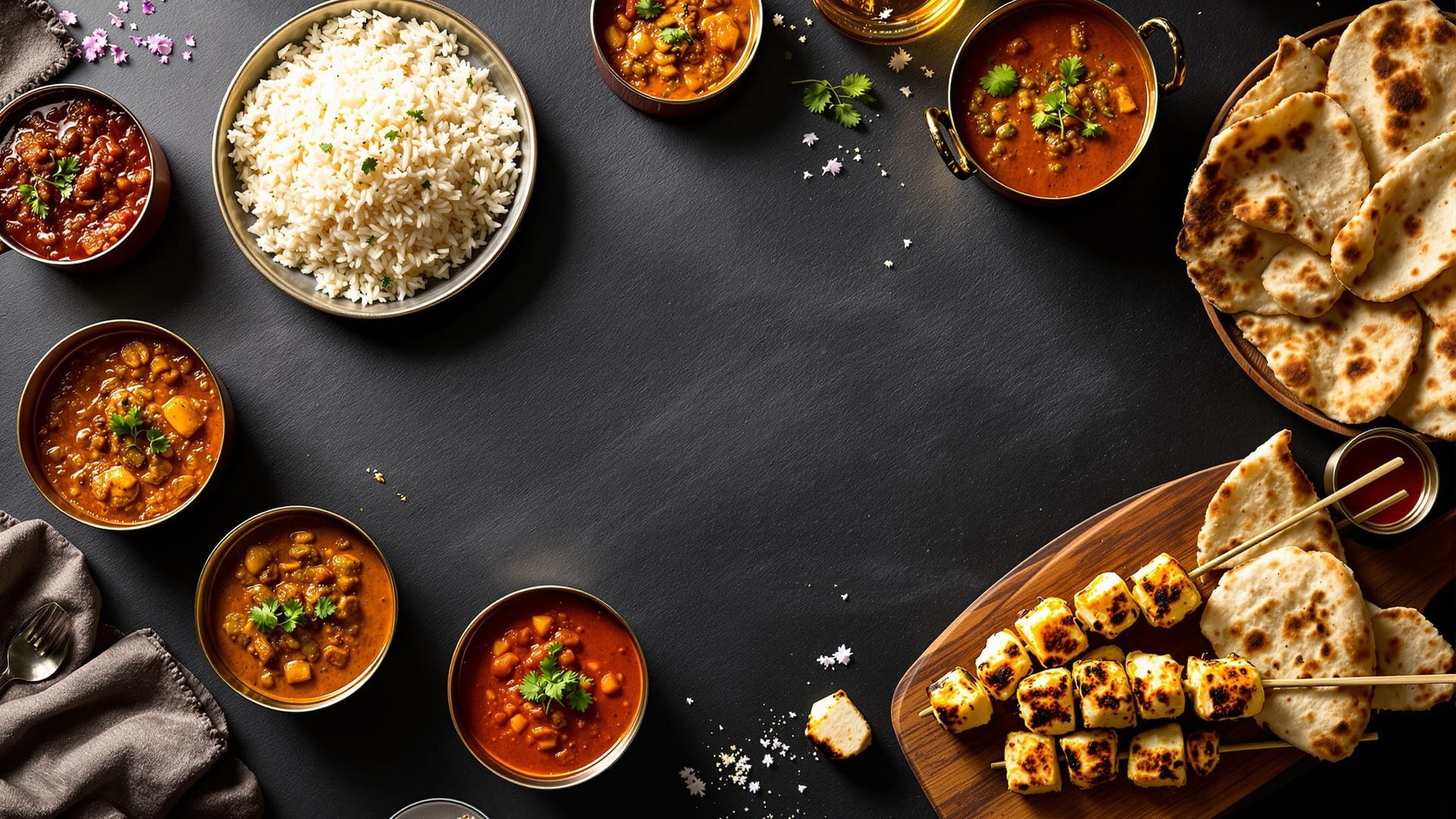
This is an archive of what Spice9 served, grouped the way an Indian restaurant kitchen groups it. There are no prices and no ordering links. The restaurant is permanently closed; a priced menu presented as current would be misleading, and a menu you can read is more useful anyway.
Read it as a document about how a mid-sized American Indian restaurant builds a card: a short appetiser list, a tandoor section that justifies the oven, a bank of gravies that share a small number of base sauces, a rice section split between biryani and Indo-Chinese, and a bread list long enough to matter.
Appetisers
The starter list did the usual two jobs — something fried, something from the tandoor. Samosas anchored it: a fried pastry triangle filled with spiced potato and peas, served with tamarind and mint chutneys. Alongside them sat pakora-style fritters and skewered tandoor items brought straight from the oven, which is really the only way to serve them.
The tandoor appetisers overlap with the mains, and deliberately so. A paneer tikka skewer is the same preparation as the paneer in a tikka masala gravy, cooked and then stopped rather than cooked and then sauced. More on how that works →
From the tandoor
The clay oven ran the day. It produced the breads, the tikka skewers — chicken, paneer, occasionally shrimp — and the kebabs. Everything from a tandoor shares one characteristic: intense, dry, direct heat from the walls and the coals at once, which chars the outside before the inside overcooks. That is why tandoor food tastes like nothing you can reproduce in a domestic oven, and why the oven is the single most expensive thing in an Indian restaurant kitchen.
Gravies and mains
The gravy section is where Indian restaurant menus look longest and are actually shortest. A kitchen builds a small number of base sauces and then varies the protein and the finish across them. The families on the Spice9 card were the standard ones:
- Tikka masala — tandoor-cooked pieces finished in a tomato and cream sauce. Spice9 ran it with chicken, with paneer, and with shrimp roasted in the clay oven first.
- Korma — the mild, nut-and-cream-thickened family, sweeter and paler than the rest.
- Saag and palak — the spinach-based gravies, most often with paneer.
- Vindaloo and chilli-forward dishes — the hot end of the card, thinner and sharper with vinegar.
- Chana, dal and vegetable gravies — chickpea, lentil and mixed-vegetable dishes that carry the vegetarian half of the menu.
Matar paneer — peas and fresh cheese in a tomato gravy — was one of the dishes the restaurant photographed for its own site, which is usually a sign a kitchen is happy with it. The paneer page covers that family in full →
Biryani
The biryani section was the most distinctive part of the menu, because it was built in the Hyderabadi dum style rather than the faster restaurant shortcut. The kitchen ran it across several proteins: a Hyderabadi vegetable dum biryani, a chicken dum biryani, a goat dum biryani, an egg biryani, and a boneless chicken version the restaurant listed as its own special.
The style is named for Hyderabad, the Deccan city where the technique was refined in the kitchens of the Nizams. Raw marinated meat and partly cooked rice go into the pot together, the lid is sealed, and the whole thing finishes on low heat in its own steam. It cannot be hurried and it cannot be made to order in ten minutes, which is precisely why so few restaurants do it properly. The full explanation →
Rice and Indo-Chinese
Beside the biryanis sat a fried rice section — vegetable, paneer, egg and chicken. This is Indo-Chinese food, a genuine hybrid cuisine that developed in Kolkata's Chinese community and is now standard on Indian menus worldwide. It is not a concession to Western palates; it is its own tradition, built on soy, vinegar, green chilli and a very hot wok.
Breads
The bread list ran well past the minimum, which is a good sign in any Indian restaurant. Plain naan and butter naan formed the base. Garlic naan was the one that came out with the buffet and the one most reviews mentioned. Paneer naan — stuffed with the same fresh cheese used across the menu — sat at the richer end, and an assorted basket let a table order the whole range at once.
All of it came off the tandoor wall, slapped on and peeled off in a couple of minutes. Bread is the fastest thing an Indian kitchen makes and the first thing that suffers if it is made early. More on the breads →
Accompaniments
Raita, chutneys and pickles rounded out the card. These are not garnishes — a cooling yoghurt raita is structurally part of how a hot biryani is eaten, and the tamarind-and-mint pair that arrives with samosas does the same job for fried starters. A menu that charges for them separately is telling you something about how it thinks about the food.
The buffet version of this menu
At lunch, a subset of the above went onto a steam table. Which subset was not arbitrary: the dishes that hold. Gravies improve for half an hour, rice holds, breads are made continuously to order. Anything that has to be finished at the pass — the delicate tandoor items, the crisp fried starters — stays on the dinner card. How the buffet was built →
For the underlying flavours behind all of it, the spice box page covers what is actually in these dishes.